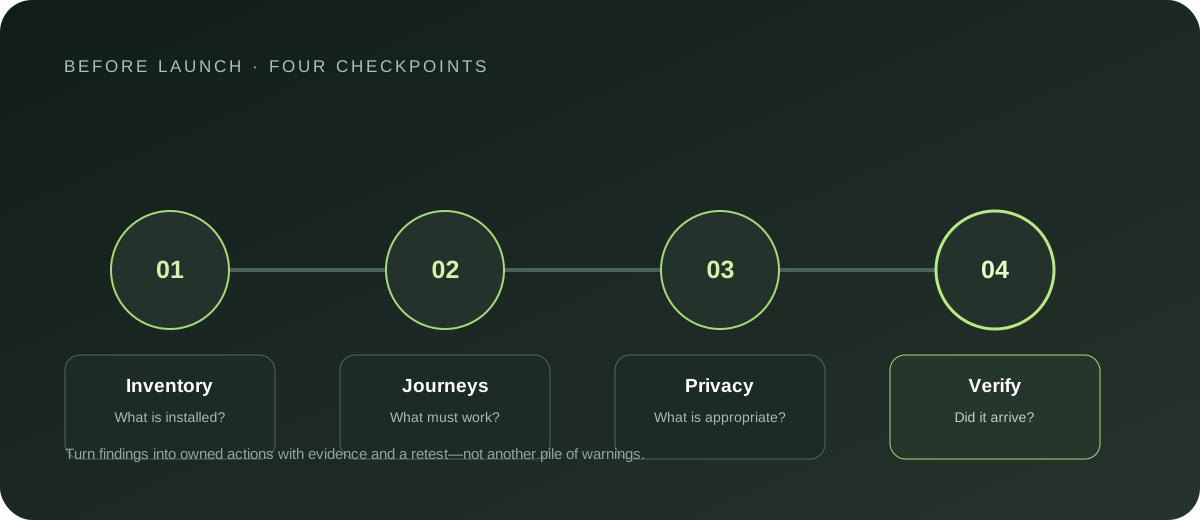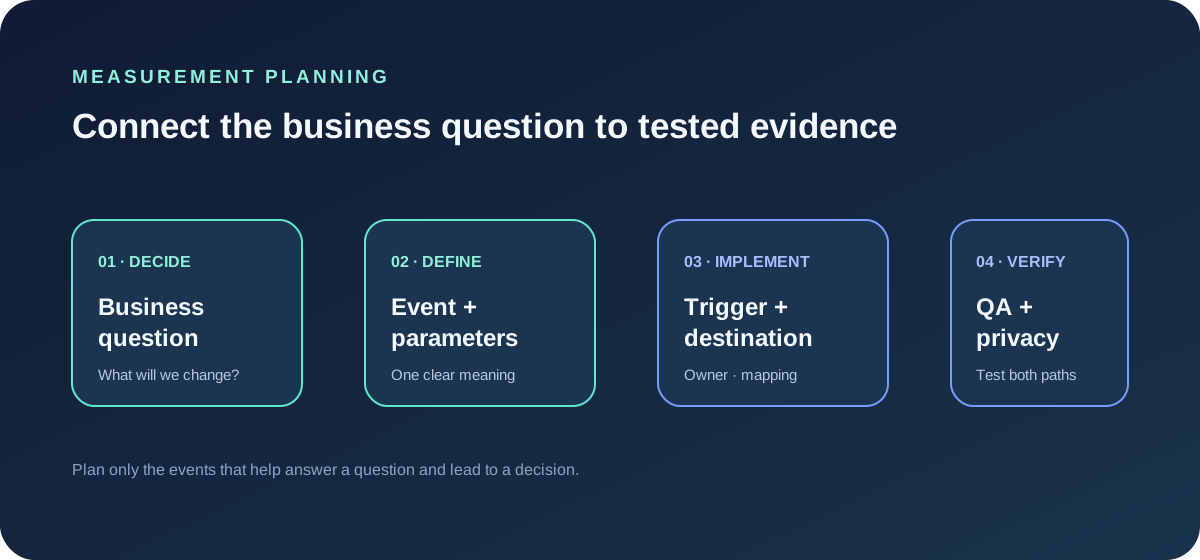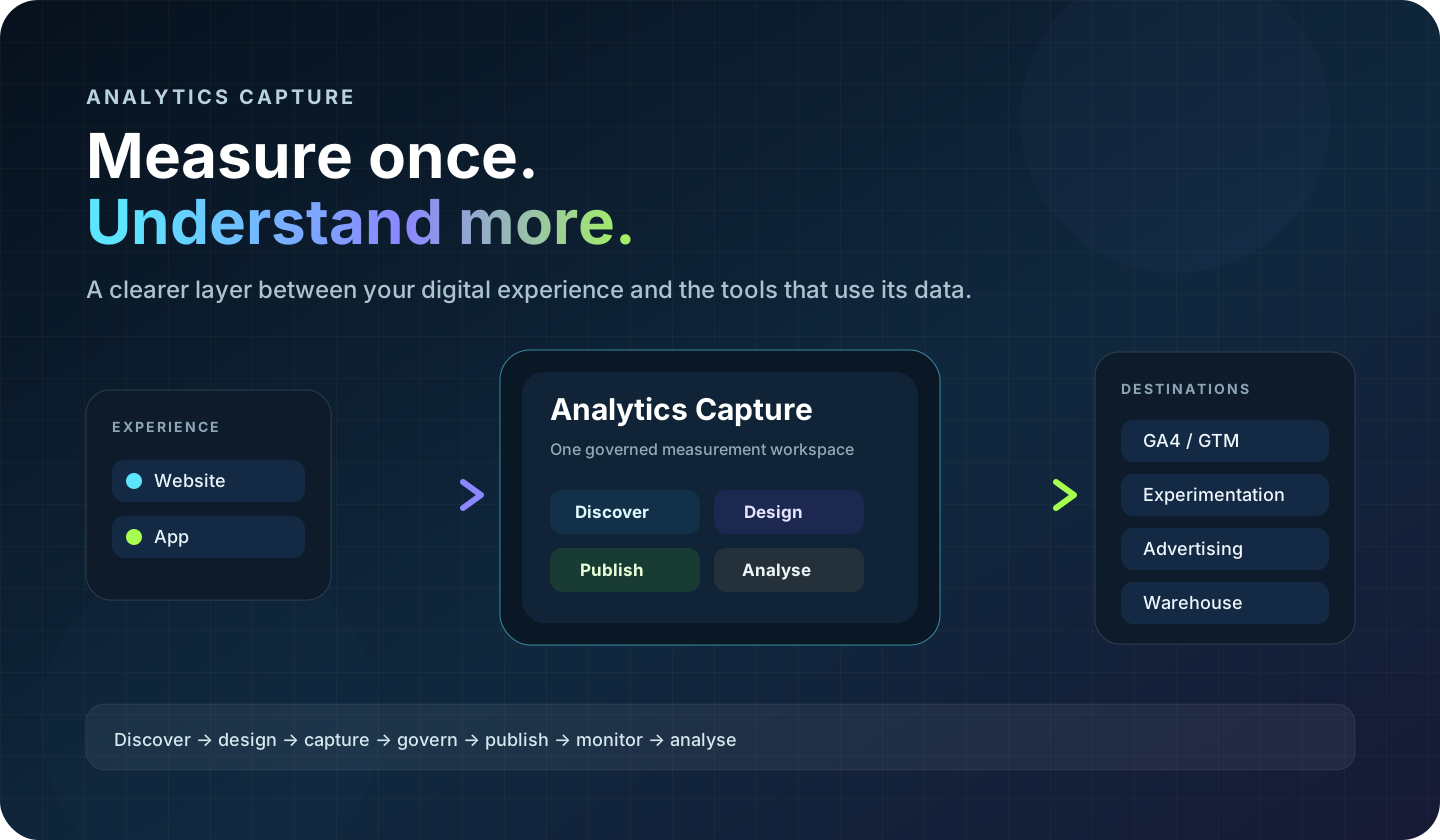
Analytics has become harder than it needs to be
Most analytics implementations do not become complicated overnight.
A team starts with GA4. Then GTM is added. Advertising pixels follow. Experimentation, session replay, consent tooling and warehouse pipelines arrive later. New features launch, new events are created and old tracking remains in place because nobody is completely sure whether it is still needed.
Eventually, answering a simple question such as “Are we tracking this correctly?” can mean checking several platforms, browser tools, consent states and implementation documents.
That is the problem Analytics Capture is being built to solve.
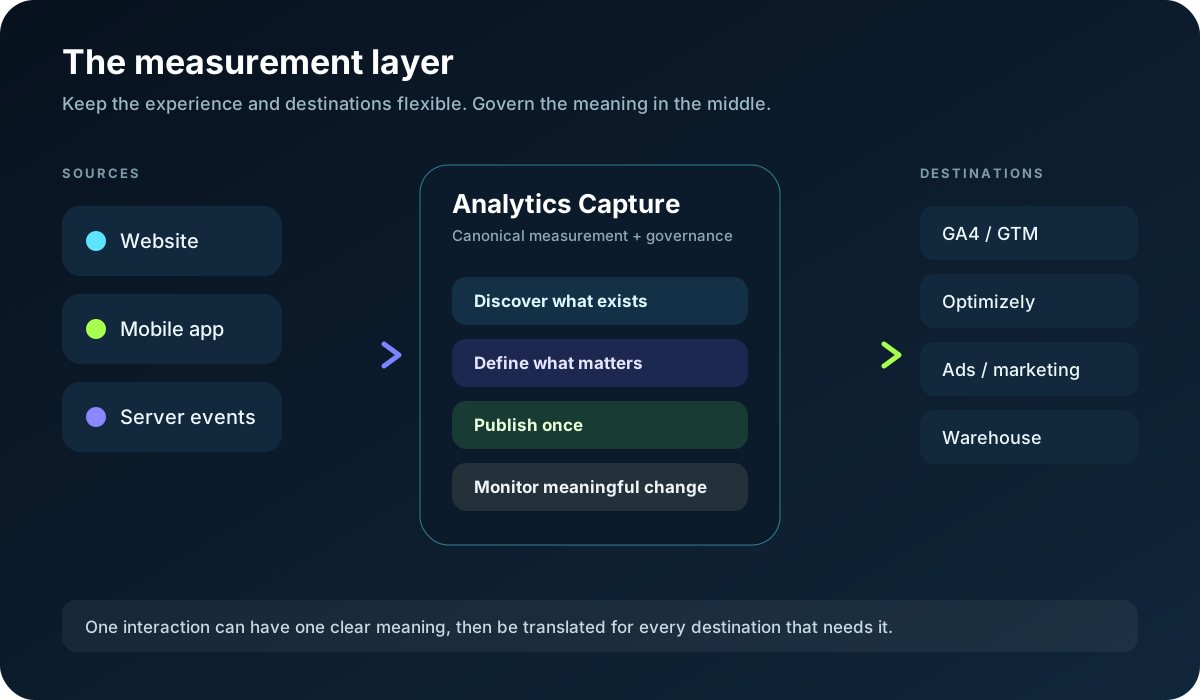
A measurement layer, not another analytics silo
Analytics Capture is a workspace for discovering, designing, governing and analysing digital measurement.
It is designed to sit alongside the tools teams already use rather than demanding an immediate rebuild. GA4, GTM, experimentation platforms, advertising destinations and data warehouses can remain part of the stack.
The difference is that the measurement logic becomes easier to understand.
Instead of maintaining several slightly different versions of the same interaction, a team can define a clear canonical event once and map it to the destinations that need it.
For example:
- product_viewed
- search_performed
- form_started
- form_completed
- account_opened
- purchase_completed
The goal is not to create the largest possible event catalogue. It is to create the smallest useful measurement system that accurately represents the customer experience.
Start with what already exists
Rebuilding tracking before understanding the current implementation is risky and usually unnecessary.
Analytics Capture starts with discovery.
It should help answer practical questions quickly:
- Which analytics and marketing technologies are present?
- What is already being captured?
- Which events look duplicated or inconsistent?
- Are important journeys missing measurement?
- What parameters are actually useful?
- How is consent affecting delivery?
- Which problems need attention now, and which can safely be left alone?
That last question matters.
An audit that returns hundreds of warnings without context has created another workload. A useful audit should reduce complexity, group related findings and make the next action obvious.
Publish clean measurement once
One of the core principles behind Analytics Capture is that measurement should become publishable, not permanently unfinished.
Teams should not need to revisit hundreds of mappings every week just because the system can generate more recommendations.
The intended workflow is closer to this:
- Discover the current implementation.
- Build a measurement blueprint around real business goals.
- Review the small number of decisions that genuinely need human judgement.
- Publish the approved measurement configuration.
- Monitor for meaningful breakage or schema drift.
- Analyse the resulting data.
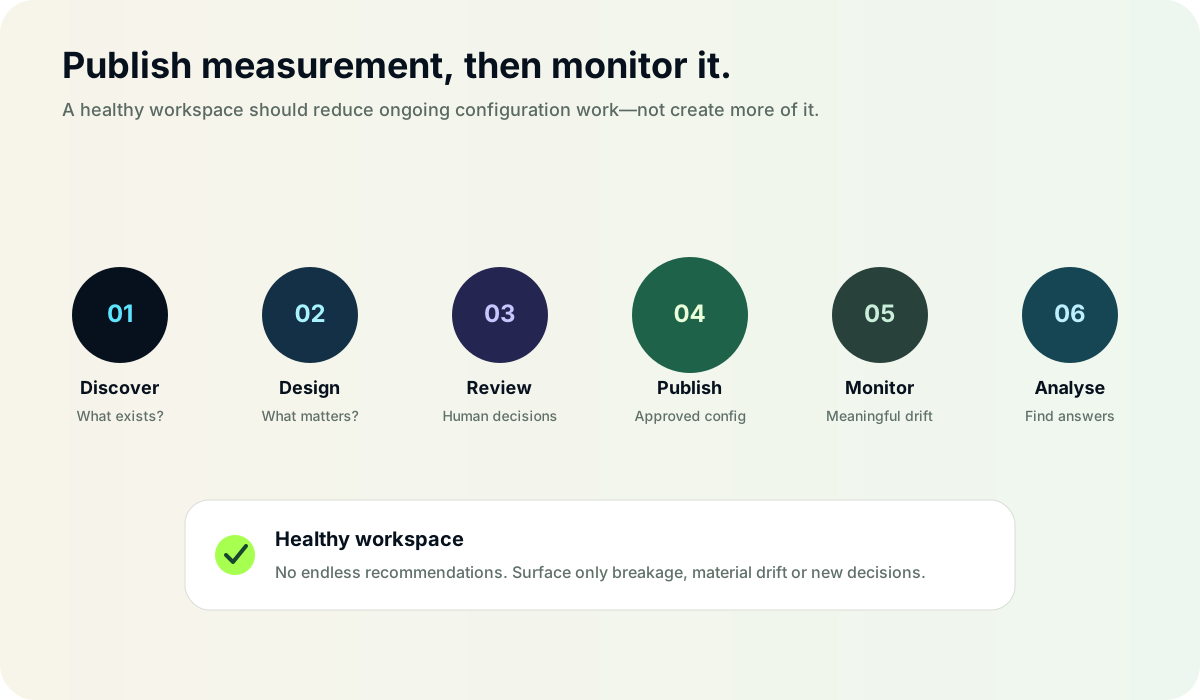
Once a workspace is healthy, the product should feel calm. It should not manufacture work to keep itself looking busy.
From business goals to useful events
Analytics often fails before the first tag fires because teams start with events rather than questions.
A more useful starting point is the business.
What is the organisation trying to achieve? What does a successful customer journey look like? Which behaviours indicate progress, friction, intent or failure?
Analytics Capture uses that context to help shape the measurement blueprint.
A subscription product and an ecommerce store should not receive the same generic event recommendations. A financial services journey, content business or marketplace has different milestones, risks and definitions of success.
The measurement plan should reflect those differences.
That makes the resulting dataset more useful for analysis later because the important concepts were designed in from the beginning.
Existing GTM and GA4 setups are part of the picture
Analytics Capture is not based on the assumption that every customer starts from zero.
Many organisations already have years of GTM, dataLayer and GA4 implementation work. Others may run Analytics Capture alongside GTM during migration or use different approaches across several sites and apps.
That needs to be supported deliberately.
The platform should be able to recognise existing tracking, distinguish it from Analytics Capture-managed measurement and help prevent the same interaction being collected twice.
A customer should be able to adopt the product gradually and still understand exactly which system owns each event.
Collection is only useful if the data can be explored
Correct tracking is the foundation, not the final product.
Once trustworthy data exists, the more interesting questions begin:
Where are users struggling?
Which journeys convert?
What changed this week?
Which segments behave differently?
Where is traffic arriving from, and what happens next?
Which behaviour looks unusual enough to investigate?
Analytics Capture is being built so that implementation and analysis live closer together. Data Studio, funnels, journeys, trends, segmentation and deeper exploratory analysis should not feel like unrelated products bolted on after tracking is complete.
The shorter the distance between measurement and insight, the more useful the system becomes.
Privacy should be designed in
Modern measurement also has to answer a second set of questions.
What information is being collected? Why is it needed? Which destination receives it? What consent or privacy rule applies?
Those decisions should not live in a spreadsheet that slowly becomes detached from production.
Analytics Capture is being designed with privacy filtering, consent-aware delivery and destination rules as part of the measurement architecture.
That means the product can help reduce accidental collection as well as improve analytics quality.
Good measurement is deliberate measurement.
AI should support the system, not disguise it
AI can be genuinely useful in analytics.
It can summarise unusual behaviour, help explain a dataset, suggest clearer naming, surface patterns and make sophisticated analysis more accessible.
But an AI answer is only as useful as the measurement underneath it.
Analytics Capture is therefore being built around a simple principle:
AI supplemented, not AI sold.
The product should provide value when the AI is doing nothing at all.
Reliable capture, clear governance, strong analysis and understandable evidence come first. AI can then make those foundations easier to use.
Advanced underneath, simple on the surface
Analytics is technical. The product does not need to pretend otherwise.
But it should expose complexity only when somebody needs it.
A product manager should be able to see whether a feature is measured.
A marketer should be able to understand whether a conversion is arriving.
An analyst should be able to interrogate the underlying data.
A developer should be able to inspect exactly what will be collected and delivered.
An advanced user should still be able to reach detailed rules, parameters and diagnostics.
Those experiences can coexist if the default journey is designed around decisions rather than configuration screens.
What Analytics Capture is building towards
The broader vision is a single measurement workspace where a team can:
- Discover its existing implementation.
- Design measurement around business goals.
- Capture meaningful interactions.
- Govern events, parameters and destinations.
- Validate implementations before and after release.
- Publish an approved measurement configuration.
- Monitor meaningful changes and failures.
- Explore behavioural data through interactive analysis.
- Understand what customers are actually doing.
All without turning analytics management into another full-time engineering project.
Why build it?
The analytics ecosystem already contains excellent products.
The problem is the space between them.
Teams still spend an enormous amount of time connecting implementation, consent, governance, debugging, documentation and analysis by hand.
Analytics Capture is an attempt to make that middle layer coherent.
Not another script whose main purpose is to collect more data.
Not another dashboard filled with charts nobody uses.
Not an AI wrapper placed over unreliable tracking.
A practical platform for making digital measurement simpler to implement, easier to trust and more useful once the data arrives.
This is the beginning
Analytics Capture is still evolving quickly, and this Measurement Lab will document that work in public.
Future articles will go deeper into GA4, GTM, consent, event design, implementation quality, experimentation, data exploration and the practical problems that appear in real analytics stacks.
The aim is for every article to be useful on its own and, where possible, to give you a way to test the idea against your own implementation.
Better analytics should mean less uncertainty, not more configuration.